Warung Bebas
Showing posts with label estimating intrinsic value. Show all posts

Monday, April 16, 2012

How to Calculate Intrinsic Value for Stock Investing


How to Calculate Intrinsic Value

Discounted Earnings, Instead of Just Cash Flow

Summarized Overview

You will find information about why you should calculate intrinsic value in stock market investing, and step by step guide on how to do it.
You will also find information about which key financial ratios to use and what you have to do after calculating intrinsic value.

Why You should Calculate Intrinsic Value

Simply because, you don't buy any stock at any price, do you? Do you know why? Because you want as much return as possible!
The price you are paying is the ultimate determinant for the rate of return that you'll be earning. The higher the price you pay for it, you'll be getting lower rate of return. This is why, you need to know how much a stock worth. Once you know its value, you can identify which stocks are traded at discounted price.
However, buying a stock simply because it is cheap is not the right approach either. This is another reason to calculate intrinsic value. To buy quality stocks at discounted price, value for money right?

How to Calculate Intrinsic Value

The way to go is, search for stocks whose prospects you believe in ( with good stock pick method ) and then use a valuation technique to ensure the purchase price is acceptable. Here, I use net present value (NPV) formula.
How to do it? Let say you are valuing stock ABC,
Case Study to calculate Intrinsic Value
From 13 years historical data, you get the information as above. To proceed, you also need to firm up your expectation based on your risk profile. In this example:
  • I set my investment horizon as long as ten years from 2007. So that in 2018 I can use the fund to finance my children's study
  • I am confident stock ABC will continue growing 13 per cent per year for the next ten years (13 years records prove this stock able to grow 13 per cent EPS per year)
  • I assume stock ABC will be having the same PER and dividend payout by end of 2017 (or early in 2018)

  • I am expecting 12 per cent return on investment (ROI) so that my initial investment able to cover my children's tuition costs in ten years time.


  • Let's start calculating intrinsic value of stock ABC.
    Step One: Forecast Share Price

    First of all, you need to forecast its share price ten years down the road. In this case, I project the price for the next ten years using 13 per cent per year growth.
    Step Two: Forecast Total Future Value

    Secondly, you need to calculate the total future value. This must include the potential dividend as well.
    Dividend Payout

    TotalEPS2017
    TotalDividend2017

    Future Value 2018
    Look, some investors doesn't care much about dividend. To them, dividend is just too small to be considered. But as it has effect to the total future value, it should be taken into consideration.
    By the end of the day, you can compare the stock's profitability to others; which may not pay any dividend at all.
    Step Three: Calculate Intrinsic Value

    After having all these data, then only you can calculate the intrinsic value for stock ABC.
    Intrinsic Value stock ABC
    Step Four: Compare with Current Stock Price

    The intrinsic value above is because my goal is to get 12 per cent per annum from this stock. If so, current stock's price, which is $33.50, is acceptable indeed (stock price is below the intrinsic value).
    How Do You
    Calculate
    Intrinsic Value?

    Discounted Cashflow
    Discounted Dividend
    Discounted Earnings
    Never Calculate
    What For?
    But if your goal is about getting 25 per cent per annum return on investment, the intrinsic value will be $22. In this case, the current stock price will no longer acceptable for you.
    For this same reason, you can say that current stock price is suit to those who are aiming for 15 per cent return per annum (in economics, this called as Internal Rate of Return or IRR)

    What's Next?

    As you can see, intrinsic value can be relatively different from one investor to another depending on the expected return. Expecting very high return will limit your investment options. On the other hand, having very low expected return may as well better keep the cash in fixed deposit.
    As an investor, it is crucial to set a realistic target on the expected profits.


    It is better if before you calculate intrinsic value of your selected stock, assess your own risk profile first. This will help you to determine your realistic preferred return based on your need, ability and investing habits.  Eager to buy stock? Hang on first! You need to have the fair value as another comparison. This is what mention by Warren Buffet's guru, the margin of safety 


    http://www.stock-investment-made-easy.com/calculate-intrinsic-value.html

    Sunday, April 15, 2012

    Calculating a Stock's Intrinsic Value (Actual Value)


    You've found a great company, possibly the best investment opportunity in your lifetime...

    Not only that, you understand the Basic Principle of Investor Return which says, "the price you pay determines your rate of return."
    So all you have to do is take advantage of your expert knowledge and buy a great company at a great price.
    Right?
    Well, almost.
    You've still got one problem left...
    How do know a company's selling for a great price?
    Easy...
    You calculate its intrinsic value.

    What's Intrinsic Value?

    In his 1938 publication "The Theory of Investment Value," John Burr Williams first articulated the idea of calculating a stock's intrinsic value.
    His idea essentially adds all of the expected future cash flows produced by a company and assigns them a present value. This present value represents the price you should pay.
    So, in financial circles, "intrinsic value" is defined as the present value of all expected future net cash flows to the company.
    Find that sentence a little hard to follow?
    So do I.
    That's why I prefer a definition that doesn't require a dictionary for interpretation.
    Here it is...
    Intrinsic value is the actual value of a company as opposed to its current market price.
    That definition makes a lot more sense, doesn't it?
    So why is intrinsic value important?
    Because if you can calculate the actual value of a companythen...
    You can compare it to the current market price.
    If the current market price is higher, then you know the company is overvalued.
    But if the current market price is lower, then you know the company is undervalued.
    Knowing what's overvalued and what's undervalued is what separates successful stock market investors from the rest of the crowd.
    Why?
    Because if you know a company is undervalued, then...
    You can buy low!
    And buying low is the key to successful investing. Right?
    Absolutely.

    How Do You Calculate Intrinsic Value?

    Sounds great, doesn't it?
    But we still haven't tackled the problem...
    How do you calculate a company's intrinsic value?
    Well, first you need current information regarding your company's...
    • Stock price
    • Average return on equity
    • Dividend payout ratio
    • Equity per share (also known as book value per share)
    • Earnings per share
    • Average P/E ratio
    Does all that information look intimidating?
    Don't worry. We'll address how to easily find each piece of information soon. Fortunately, it's all on the Internet!
    Once you have all this information at your fingertips, you can easily calculate your company's intrinsic value by estimating its earnings for the next ten years.
    The following chart uses The Coca-Cola Company as an example to illustrate how easy this is...
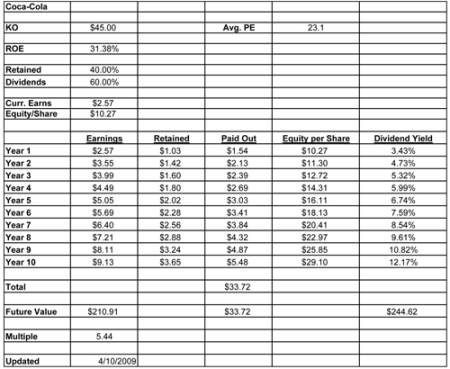
    We'll address how to use this chart in moment.
    But first, let's get those figures...

    How to Find the Numbers You Need

    Before you can calculate a stock's intrinsic value, you need to know several pieces of information about the company and its stock.
    Here's how to find each piece of information...
    Current Stock Price - This one's easy. Just go to Yahoo! Finance or Google Finance or dozens of other places on the web where you can get real-time stock quotes. Plug in your company's stock ticker, and you've got it.
    Average Return on Equity - While most online services like Yahoo! Finance provide a figure for return-on-equity, it most likely represents the current year only. To get a more accurate number for your intrinsic value calculation, go to Google Finance, type in your company's ticker symbol, and find the text link titled "More ratios from Thomson Reuters."
    Follow that link, and you'll find a category titled "Management Effectiveness." Find the figure for "Return on Equity -5 yr. Avg."
    It's best to use a company's five- or ten-year average return on equity as opposed to a single year when calculating intrinsic value.
    Why?
    Because a dramatically higher or lower one-year return on equity can throw off your entire calculation. So if you want the most accurate calculation possible, use a long-term average return on equity.
    In my opinion, The Value Line Investment Survey offers the best return on equity figures. Visit your local library, and you can find a company's return on equity every year for the last ten years as well as Value Line's projections for the company's ROE over the next five years.
    For best results, use Value Line figures for your intrinsic value calculations.
    Current Dividend Payout Ratio - Again, go to Google Finance, type in your company's ticker symbol, and find the text link titled "More ratios from Thomson Reuters."
    Follow that link, and you'll find a category titled "Dividends." Find the figure for "Payout Ratio (TTM)." That's the percentage of earnings your company pays out in dividends.
    Current Equity Per Share - Go to Yahoo! Finance, type in your company's ticker symbol, and find the text link titled "Key Statistics." Find the category titled "Balance Sheet," and find the figure for "Book Value per Share." This is the current equity per share, also known as book value.
    Current Earnings Per Share - Go to Yahoo! Finance, type in your company's ticker symbol, and find the figure for EPS. This is the earnings per share.
    However, keep in mind that Yahoo! Finance and most online services report a company's last four quarterly earnings figures as the EPS, so this figure might be distorted by a one-time expense or charge-off due to otherwise favorable long-term investments by the company.
    So make sure you perform due diligence when searching for an accurate earnings per share figure for your intrinsic value calculation. Again, The Value Line Investment Surveyprovides the most accurate figures.
    Average P/E Ratio - This isn't a ratio I?ve run across on Yahoo! Finance or Google Finance, so I performed a Google search to find a good site. A site called ADVFN popped up. If you follow this link to their site, and scroll down to the category "Valuation Ratios," you'll find a figure titled "5-Y Average P/E Ratio." This is the company's five-year average P/E ratio.
    But again, you can find a far more accurate ten-year P/E ratio by visiting your local library and consulting The Value Line Investment Survey. The figure they provide is the one I personally use.

    Using Excel to Calculate Intrinsic Value

    Once you've gathered all the necessary information, you can use Excel to calculate a stock's intrinsic value.
    The previous image, using The Coca-Cola Company (KO), is a good example of this...
    Do all those spreadsheet formulas and calculations look confusing?
    Fortunately, I've already set them up for you!
    All you have to do is plug in the customized numbers for your company...
    And you can use the exact same Excel spreadsheet I use for calculating a company's intrinsic value.
    Download Britt's Intrinsic Value Spreadsheet >>>
    Just replace the numbers in the yellow-highlighted cells with your company's numbers, and the spreadsheet will calculate a value titled "Multiple" on line 29.
    Line 29 is the calculation you're looking for.
    If your great company has a number above 5.00, it's currently undervalued.
    If it's below 5.00, then the stock is currently overvalued...
    Why 5.00?
    Because a multiple of 5.00 means you'll make a 5-fold return on your investment in the next ten years if you buy the company at its current price.
    A 5-fold return in ten years is a 17.46% annual compounding rate of return.
    Also, five is a nice round number, and I like nice round numbers.
    No kidding...
    Think that's a silly reason for picking 5.00?
    It's really not.
    Always keep in mind, calculating intrinsic value is an art, not an exact science.
    The spreadsheet's calculations act as a guide, not a precise road map.
    As Warren Buffett says...
    "It's better to be approximately right than precisely wrong."
    So a figure above 5.00 means you're approximately right.
    But there's another reason you want a 5-fold investment return and not a 4-fold or a 6-fold return...
    Remember, if achieved, a 5-fold return is a 17.46% annual compounding rate of return.
    This beats the S&P 500's fifty year track record of 10.85% by more than six points.
    Now, in order to make all your time and effort researching stocks a worthwhile endeavor, you need to beat the market by at least a couple of points per year.
    Over time, those couple of points will add up to a lot.
    And while achieving a 4-fold return over ten years (a 15% annual compounding rate of return) achieves your goal of beating the market by more than a few points...
    You need to remember, calculating a stock's intrinsic value is an estimating tool. It's more art than exact science.
    So as a precaution, give yourself a little room for error.
    Force your potential investment to live up to a higher standard...
    Tack an extra 25% onto that 4-fold return, and give yourself a new goal of a 5-fold return.
    That way, if you fall short of your goal, you still have a good shot at beating the market averages.
    Remember...
    "It's better to be approximately right than precisely wrong."
    So give yourself a little bit of leeway in case something goes wrong.
    In investment circles, this idea is known as the margin of safety.

    Providing a Margin of Safety

    Benjamin Graham first put forth the idea of a margin of safety in his groundbreaking bookSecurity Analysis (1934), which he co-authored with colleague David Dodd.
    According to Graham, margin of safety is the secret to a sound investment philosophy...
    "Confronted with a like challenge to distill the secret of sound investment into three words, we venture the following motto, Margin of Safety."
    So what's a margin of safety?
    It's nothing more than giving yourself a little room for error.
    Just ask yourself, "If things fail to go perfectly, will my investment still work out?"
    If not, there's no margin of safety.
    However, if your company's earnings fall well short of your projections and you can still achieve your desired investment returns...
    Then, you have a margin of safety.
    By purchasing only those stocks which offer a significant margin of safety, you limit your downside risk and significantly increase your odds of success.

    Conclusion

    Learn how to calculate a stock's intrinsic value. It's a skill that will prove invaluable over the course of your investing lifetime.
    Use the spreadsheet located in the middle of this page. Look for companies with a multiple in excess of 5.00 at the current price.
    However, remain mindful of other variables. Some companies look like they're dirt cheap, and they are. These companies will make you a fortune if you're prudent enough to buy them.
    But other companies also look like they're dirt cheap, while in reality, they're grossly overvalued...
    So how do you tell the difference?
    By following all the rules previously outlined for finding a great company...
    Also, I can't emphasize this enough - ask question after question about your company's future business prospects and apply your own common sense and good judgment. This will go a long way toward determining your investment success...
    After all, if numbers told the entire story, no one would think about their investment decisions at all. We'd all just let computer programs "run the numbers" on our investments. Right?


    http://www.your-roth-ira.com/calculating-a-stocks-intrinsic-value.html

    How to Calculate Intrinsic Value for Stock Investing


    How to Calculate Intrinsic Value
    Discounted Earnings, Instead of Just Cash Flow

    Summarized Overview

    You will find information about why you should calculate intrinsic value in stock market investing, and step by step guide on how to do it.
    You will also find information about which key financial ratios to use and what you have to do after calculating intrinsic value.


    Why You should Calculate Intrinsic Value

    Simply because, you don't buy any stock at any price, do you? Do you know why? Because you want as much return as possible!
    The price you are paying is the ultimate determinant for the rate of return that you'll be earning. The higher the price you pay for it, you'll be getting lower rate of return. This is why, you need to know how much a stock worth. Once you know its value, you can identify which stocks are traded at discounted price.
    However, buying a stock simply because it is cheap is not the right approach either. This is another reason to calculate intrinsic value. To buy quality stocks at discounted price, value for money right?

    How to Calculate Intrinsic Value

    The way to go is, search for stocks whose prospects you believe in ( with good stock pick method ) and then use a valuation technique to ensure the purchase price is acceptable. Here, I use net present value (NPV) formula.
    How to do it? Let say you are valuing stock ABC,
    Case Study to calculate Intrinsic Value
    From 13 years historical data, you get the information as above. To proceed, you also need to firm up your expectation based on your risk profile. In this example:


    • I set my investment horizon as long as ten years from 2007. So that in 2018 I can use the fund to finance my children's study
    • I am confident stock ABC will continue growing 13 per cent per year for the next ten years (13 years records prove this stock able to grow 13 per cent EPS per year)
    • I assume stock ABC will be having the same PER and dividend payout by end of 2017 (or early in 2018)

  • I am expecting 12 per cent return on investment (ROI) so that my initial investment able to cover my children's tuition costs in ten years time.


  • Let's start calculating intrinsic value of stock ABC.
    Step One: Forecast Share Price

    First of all, you need to forecast its share price ten years down the road. In this case, I project the price for the next ten years using 13 per cent per year growth.
    Step Two: Forecast Total Future Value

    Secondly, you need to calculate the total future value. This must include the potential dividend as well.
    Dividend Payout

    TotalEPS2017
    TotalDividend2017

    Future Value 2018
    Look, some investors doesn't care much about dividend. To them, dividend is just too small to be considered. But as it has effect to the total future value, it should be taken into consideration.
    By the end of the day, you can compare the stock's profitability to others; which may not pay any dividend at all.
    Step Three: Calculate Intrinsic Value

    After having all these data, then only you can calculate the intrinsic value for stock ABC.
    Intrinsic Value stock ABC
    Step Four: Compare with Current Stock Price

    The intrinsic value above is because my goal is to get 12 per cent per annum from this stock. If so, current stock's price, which is $33.50, is acceptable indeed (stock price is below the intrinsic value).
    How Do You
    Calculate
    Intrinsic Value?

    Discounted Cashflow
    Discounted Dividend
    Discounted Earnings
    Never Calculate
    What For?
    But if your goal is about getting 25 per cent per annum return on investment, the intrinsic value will be $22. In this case, the current stock price will no longer acceptable for you.
    For this same reason, you can say that current stock price is suit to those who are aiming for 15 per cent return per annum (in economics, this called as Internal Rate of Return or IRR)

    What's Next?

    As you can see, intrinsic value can be relatively different from one investor to another depending on the expected return. Expecting very high return will limit your investment options. On the other hand, having very low expected return may as well better keep the cash in fixed deposit.
    As an investor, it is crucial to set a realistic target on the expected profits.


    It is better if before you calculate intrinsic value of your selected stock, assess your own risk profile first. This will help you to determine your realistic preferred return based on your need, ability and investing habits.
    Eager to buy stock? Hang on first! You need to have the fair value as another comparison. This is what mention by Warren Buffet's guru, the margin of safety 

    http://www.stock-investment-made-easy.com/calculate-intrinsic-value.html


    Related Reading

    How to Value Stock - 3 Methods Warren Buffet Wants You to Learn
    If you are looking for ways on how to value stock, click here. I'll share with you 3 stock valuation model most commonly used by stock analyst.

    Additional Reading

    How to Determine Margin of Safety in Stock Investing
    Margin of safety is a way to preserve capital. Find out how to determine fair value for each stock effectively.
    Guide in Analyzing Company for Stock Investing
    Four guidelines in analyzing company that you are about to invest in. Find how companies difference to each other.
    Fundamental Analysis: Definition and Basic Guide for Beginners
    Fundamental analysis is a practice that attempt to determine stocks’ valuation. This technique is focusing on the underlying factors that affect the company’s actual business performance.
    Unlimited Profits From Good Stock Pick
    Discover my simple but profitable stock screening criteria. It is proven to be a good stock pick strategy for all stock investors.

    Related Books

    Security Analysis
    Security Analysis is the bible of fundamental analysis. Originally published in 1934, the tome systematically lays bare the science of security analysis.
    Value Investing: From Graham to Buffett and Beyond (Wiley Finance)
    Discusses where to look for underpriced securities, how to determine the intrinsic value of a stock, and alternative methods for constructing a portfolio that control risk without restricting investment return.
    The Intelligent Investor: The Definitive Book on Value Investing. A Book of Practical Counsel (Revised Edition)
    Among the library of investment books promising no-fail strategies for riches, Benjamin Graham's classic, The Intelligent Investor, offers no guarantees or gimmicks but overflows with the wisdom at the core of all good portfolio management.

    Tuesday, April 10, 2012

    Valuing a Business

    "The critical investment factor is determining the intrinsic value of a business and paying a fair or bargain price."

    - Warren Buffett

    Saturday, March 10, 2012

    For practical purposes, it is sometimes sufficient to estimate either the upper bound or the lower bound of the investment value range of a stock.

    The investment value of a stock is conceptually a single point value, the mean of the distribution of investment value. Operationally, investment value is estimated as a range of values. 


    For practical purposes, it is sometimes sufficient to estimate either the upper bound of the investment value range to deselect a stock or the lower bound of the investment value range to select a stock. 

    • As an example, if the upper bound of investment value of a given stock is confidently estimated to be no higher than $50 per share and the current quoted market price for this stock is $75 per share, then this particular stock can be deselected. 
    • Similarly, if the lower bound of investment value of another stock is confidently estimated to be at least $50 per share and the current quoted market price for this stock is $25 per share, then this particular stock can be selected.

    Concerning the range of estimated appraisal values, Williams (1954:32-33) explained: 
    "Scholar: Yes, economics supplies the answer to many questions of great practical importance. 
    Skeptic: How can it possibly do so if it lacks the mathematical precision of astronomy? 
    Scholar: Economics is more like chemistry than it is like astronomy. Or rather, it is like that branch of chemistry known as qualitative analysis, in contrast to quantitative analysis. In economics, just as in qualitative analysis, you don't always have to have an exact answer to have a useful one. For instance, if a chemist testifies in court that a dead man was found to have enough arsenic in his system to kill an ox, let alone a human being, then it really doesn't matter whether the amount of arsenic involved is two grams or ten, so long as the chemist is absolutely sure that what he found was really arsenic and not a related substance like tin or antimony. Precise measurement is unnecessary. The same is true in economics.

    The four basic factors needed to appraise the intrinsic value of an operating enterprise and thus its common stock equity


    An important distinction is the difference between reported accounting value (book value or net worth per share) and intrinsic economic value (discounted future dividends per share).

    • Book value does not reflect inflation and obsolescence, nor does it include intangible assets such as "franchises" and technological prowess resulting from R&D expenditures. 
    • In addition, book value per share is merely a mechanical screening ratio set at an arbitrary cutoff point which does not reflect judgment and does not reliably distinguish between underpriced bargain stocks and fairly-priced junk stocks.


    Intrinsic economic value of an operating enterprise is appraised by use of discounted cash flow techniques in the so-called dividend discount model originated by John Burr Williams.

    • He made allowance for both dividends and future selling price. 
    • He also explains how the transposed dividend discount model can be used to determine what the market as a whole is expecting, and this can be compared with the investor's expectation.


    As John Burr Williams (1938: page 466) wrote: "in other words, Investment Analysis usually measures the relative rather than the absolute value of any stock, and leaves to the economist the broad question of whether stocks in general are selling too high or too low. ... From the point of view of this book, which is concerned with absolute rather than relative value, ... "

    According to Williams (1938), the four basic factors needed to appraise the intrinsic value of an operating enterprise and thus its common stock equity, two economy-wide factors and two company-specific factors. The economy-wide factors are general price level inflation and the real interest rate. The company-specific factors are the estimated future net cash distributions to the stockholders and the discount rate or rates applied to those cash receipts. For foreign companies, a fifth factor may be required: the currency exchange rate, which is discussed at length by Williams (1954). This is important enough to justify a table to repeat it for emphasis.
    Factors of Intrinsic Economic Value
    Number
    Description
    1
    general price level inflation rate
    2
    real interest rate
    3
    dividends or free cash flows to equity
    4
    discount rate or rates
    5
    currency exchange rate, where applicable

    Friday, March 9, 2012

    The quantity of value is an estimate or approximation. Intrinsic value can be quantified as Net Present Value (NPV) based on Discounted Cash Flow (DCF) analysis.

    The quantity of value is an estimate or approximation. The estimated quantity of value is based on an appraisal or a valuation. It can be expressed either as 

    • an interval estimate or 
    • a range of quantitative values, or 
    • as a single-point estimate or 
    • a single quantity of varying precision. 
    Either way, intrinsic value can be quantified as Net Present Value (NPV) based on Discounted Cash Flow (DCF) analysis.

    Price is not value, neither in concept nor in quantity. Price is a market-generated quantity. 

    • The confusing term "market value" is really market price. 
    • The confusing term "fair market value" is really fair market price. 
    • The fair market price is the price that equals the single quantity that best approximates investment value. 
    The best point estimate of investment value is the mean of the distribution of values rather than the median of the distribution of values or the midpoint of the range of values.
       

      My Investing Notes Copyright © 2012 Fast Loading -- Powered by Blogger