The investment industry is replete with pundits and self-proclaimed experts espousing various principles and rules that allegedly are the best way to value a stock correctly. Unfortunately, and in most cases, these rules are stated as fact, but unfortunately very few facts are ever presented to back them up. In other words, much of it is either opinion or gleaned from something they’ve read or been taught before. But even as a young boy, I was never willing to accept dogma as fact without simultaneously being provided supporting evidence and a logical explanation as to the “why” that they work.
In fifth grade I was once sent to the principal’s office by my English teacher because I made her cry. She cried because every time she would regurgitate a rule of grammar, punctuation or spelling, she expected me to accept it unconditionally, merely because she said so. For example, she would say something like I before E except after C expecting me to simply accept this rule as fact. I, on the other hand, not meaning to be argumentative or disruptive, only inquisitive, would immediately raise my hand in class and ask a simple question-why? No matter what rule she would state, I would relentlessly raise my hand and ask okay, but why? I was not willing to have the rule dictated to me; I needed to understand why it was the rule and why it was important.
Now that I am an adult, I have continued to embrace my inquisitive nature, and to this day I will not accept a dogmatic statement without understanding why. On the other hand, when I can review supporting evidence that validates the rule and therefore understand its significance, relevance and validity, then and only then, through my understanding it, can I embrace it willingly and passionately. Therefore, as an author of financial articles, I believe my readers should hold me to this same standard that I hold others to. Consequently, this article is designed to illuminate the “why” behind widely accepted notions of valuing a business primarily based on earnings (discounting cash flows).
When Investing in a Business Earnings Determine Intrinsic Value
In his best-selling book One Up On Wall Street, famed portfolio manager Peter Lynch dedicated his entire 10th chapter to earnings and thus titled it –Earnings, Earnings, Earnings. In the chapter’s second paragraph he succinctly stated the importance of earnings as follows:
“There are many theories, but to me, it always comes down to earnings and assets. Especially earnings. Sometimes it takes years for the stock price to catch up to a company’s value, and the down periods last so long that investors begin to doubt that it will ever happen. But value always wins out-or at least in enough cases that it’s worthwhile to believe it.”
An important foundational principle behind this discussion is the idea that we are talking about investing as part owners of strong businesses, rather than trading stocks. Business owners are rewarded through the profits the companies they own are capable of generating on their behalf. These rewards can come in the form of salaries and bonuses for active owners, and from increasing value or cash flow from dividends for passive shareholders. In either event, all these rewards are ultimately a function of the businesses’ earnings capability, at least in the longer run. Therefore, we should realize that when you truly invest in a stock, you really are investing in its ability to earn more money for you in the future.
When I first read Peter Lynch’s famous book in 1990, I had already developed a strong belief in the importance of earnings regarding assessing the fair value of an operating business. Therefore, the theory behind Peter Lynch’s wisdom already resonated deep within me. However, as already stated, it was the facts behind the theory that interested me the most. In fact, I was so committed to the notion that earnings determine market price, that I developed my own stock graphing tool that allowed me to evaluate the true relationship between a company’s earnings and its stock price over time.
The following additional quotes from Chapter 10 of Peter Lynch’s book titled: Earnings, Earnings, Earnings, speak to the importance of valuing a business based on its earnings power:
“you can see the importance of earnings on any chart that has an earnings line running alongside the stock price…. On chart after chart the two lines will move in tandem, or if the stock price stays away from the earnings line, sooner or later it will come back to earnings.”
A few pages later, Peter offers us another nugget of wisdom on the earnings and price relationship, plus a little bit of investing advice thrown in:
“a quick way to tell if a stock is overpriced is to compare the price line to the earnings line……. If you bought familiar growth companies…… when the stock price fell well below the earnings line, and sold them when the stock price rose dramatically above it, the chances are you would do pretty well.”
Now that we’ve reviewed some investing axioms and nuggets from Mr. Peter Lynch, let’s see if we can perform two extremely important tasks.
- First and most importantly, let’s see if we can answer the more important question as to why earnings determine market price; not just that it does.
- Next, let’s produce some evidence that verifies the veracity of Mr. Peter Lynch’s words.
In order to accomplish both of these important tasks we will rely on visual representation, and mathematical proofs provided by F.A.S.T. Graphs™. How to Value a Company’s Earnings and WhyThe essential point underpinning the thesis of this article, is that when you’re investing in a business you’re not actually buying the stock,
you’re buying the company’s earnings power. The stock is only the vessel that contains the earnings you are purchasing. When buying earnings, the principles of value apply just like they do with any other product or service. The easiest way to understand this clearly, is to
think in terms of the price you pay to buy $1 dollar’s worth of one company’s earnings versus $1 dollar’s worth of another company’s earnings.In other words,
let’s look at two companies to see what the price, and therefore, value, of $1 dollar’s worth of earnings are. However, before we do, let’s establish some doctrine that we are going to focus on. First and foremost, remember that we are going to buy $1 dollar’s worth of earnings for each of our two companies. Now, we need to clearly understand that once either of those dollar’s worth of earnings are taken out of the business and put into our pockets, the value of each dollar’s worth of earnings is precisely the same.
When separated from the business, a dollar is a dollar, and a dollar from one company will buy no more or no less than a dollar from another company.However, we also have to deal with the fact that $1 dollar’s worth of each respective company has a different cost. This then begs the question, why? - In other words, why would we pay more to buy company A’s dollar worth of earnings than we would to buy Company B’s dollar worth of earnings?
- Since a dollar’s worth of each company’s earnings once received outside of the business is worth exactly the same, why would we pay more to buy one of the dollars than the other?
The reason, as we will develop more fully later, is that if we are long-term investors in businesses, we are actually buying future earnings, not current earnings. Therefore, the amount of earnings we accumulate in the future will be a function of the company’s earnings growth rate, and will determine what price we paid today to buy those future earnings of tomorrow. Let’s clarify this by examining the dynamics of our two example companies. We will start with history presented as evidence of
what has actually already happened, and then
we will move on to the future, which we believe is
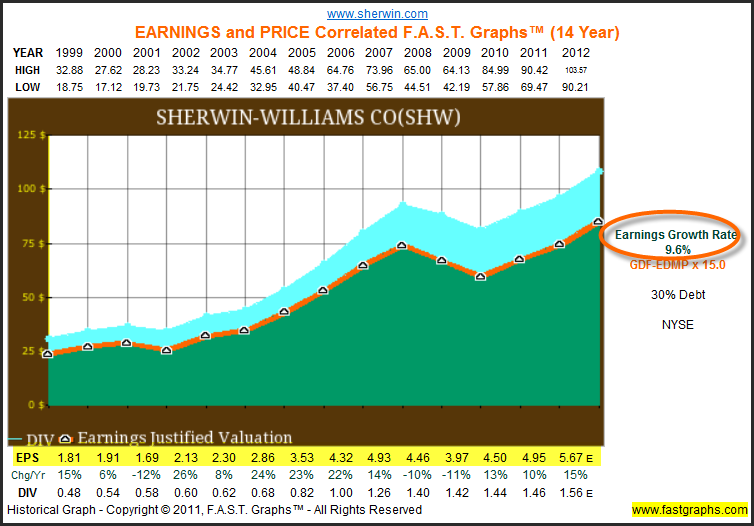
actually more relevant.Our first example is Sherwin-Williams Co. (SHW), which has achieved a
historical earnings growth rate of 9.6% since 1999. At the bottom of the graph you can see that earnings have grown from $1.81 per share in 1999, to an estimate of $5.67 per share for fiscal 2012 (see yellow highlighted earnings at the bottom of the graph). This represents approximately a three-fold increase in earnings over the past 14 years.
The primary point is that every $1 dollar’s worth of earnings you bought in 1999, are now worth approximately $3 dollars. Another way to put this is that Sherwin-Williams’ future dollars in 2012 only cost one third as much as the original $1 dollars worth of earnings cost in 1999.Our second example, CSX Corp. (CSX),
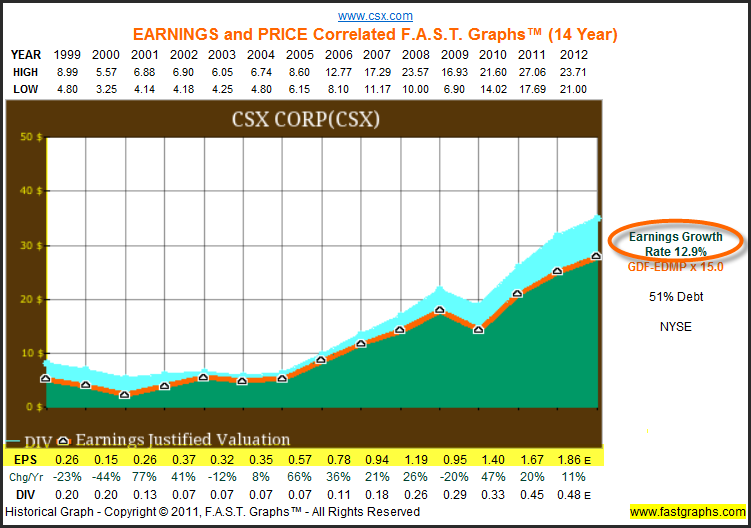
grew earnings per share at the higher rate of 12.9% since calendar year 1999. Therefore, earnings per share grew from $.26 a share in calendar year 1999 to $1.86 per share estimated for fiscal year-end 2012 (see yellow highlighted earnings at the bottom of the graph). This is approximately a
seven-fold increase in earnings per share over this 14-year period. The primary point is that every $1 dollar’s worth of earnings you bought in 1999, are now worth approximately $7 dollars. Consequently, shareholders that bought CSX in 1999 only paid 1/7th of the original price for calendar year 2012 earnings. In other words,
due to the company’s historical earnings growth rate, future earnings were significantly cheaper than original earnings. As we will discover next, herein lays the essence of fair value, or what others call intrinsic value of a business (common stock).Now let’s move to
current time to examine
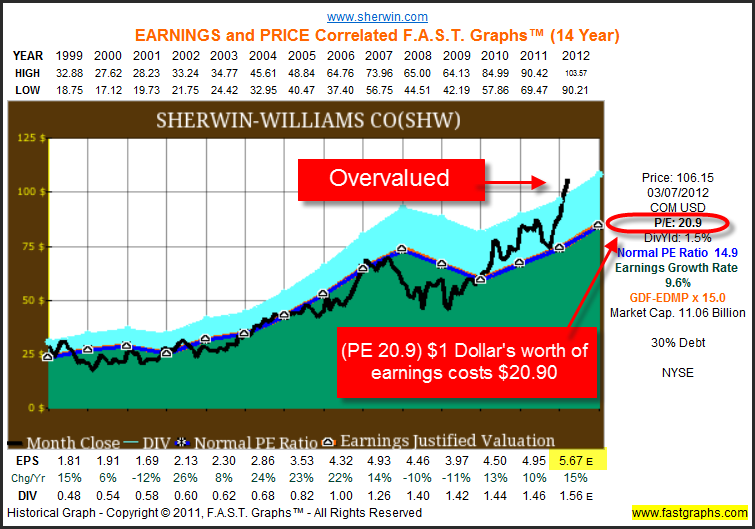
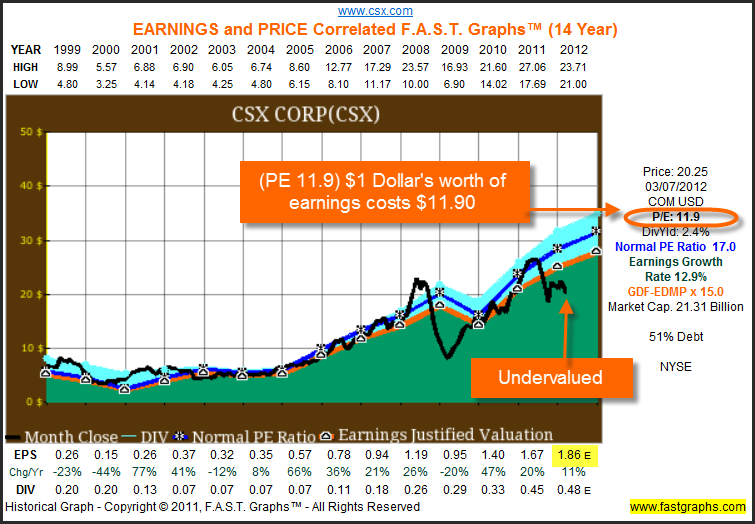
what price we have to pay to buy $1 dollar’s worth of each of our example company’s earnings today, and attempt to calculate what $1 dollar’s worth of future earnings are actually costing us. The metric that establishes that price is the common PE ratio. One of the definitions of the PE ratio is: The price you pay to buy $1 dollar’s worth of a company’s earnings. Remember though, we are pricing $1 dollars worth of today’s earnings, even though
in actuality what matters most is the price we’re paying to buy $1 dollars worth of future earnings.In the case of Sherman-Williams (SHW), today we are asked to pay $20.90 (current PE ratio 20.9 see red circle at right of graph ) to buy our $1 dollar’s worth of current earnings. As an aside, you can note from the graph that this is the highest valuation or price that you were asked to pay to buy a $1 dollar’s worth of Sherwin-Williams’ earnings since 1999. In other words, Sherwin-Williams’
stock appears very expensive today based on historical earnings growth.In the case of our second example, CSX Corp. we discover that we are only being asked to pay $11.90 (current PE 11.9 see orange circle at right of graph) to buy $1 dollar’s worth of CSX Corp.’s current earnings.
This is almost half the price we are being asked to pay to buy an equivalent $1 dollar’s worth of Sherwin-Williams Co.’s earnings. Therefore, the rational investor should ask this simple question:
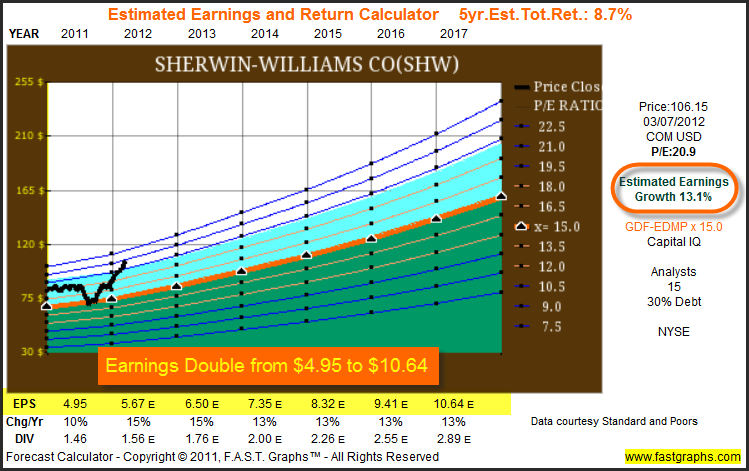
Why should I be willing to pay almost twice as much to buy Sherwin-Williams’ earnings as I’m being asked to buy CSX’s earnings? The only logical answer would be because future earnings are expected to be much higher for Sherwin-Williams Co. than for CSX Corp. But in fact, this is not true, and as we will next illustrate, the real answer doesn’t make any mathematical sense.Utilizing the Estimated Earnings and Return Calculator we discover that the consensus (15 analysts reporting to Capital IQ)
estimate earnings growth rate for Sherman-Williams at a very strong 13.1%. This calculates out that expected calendar year 2017 earnings of $10.64 will be approximately twice as large as 2011’s earnings of $4.95. Therefore, we are,
in theory at least, only paying approximately $10 today to buy a future $1 dollar’s worth of Sherwin-Williams’ 2017 earnings. In other words, the PE ratio of the future earnings we are buying is approximately 10, or half of what we have to today pay for current earnings.Once again, utilizing the Estimated Earnings and Return Calculator we discover that the consensus (26 analysts reporting to Capital IQ)
expect CSX Corp. to grow earnings at a very strong rate of 14%. This calculates out that CSX Corp.’s expected earnings in 2017 will also be approximately 2 times larger than today’s earnings of $3.63 in 2017 versus the original $1.67 in 2011.
To be clear, this means that the earnings growth rates in both of our sample companies are expected to be essentially the same or at least similar.Most importantly, it also means that we are only paying a PE of 5.6 to buy CSX Corp.’s $1 dollar’s worth of future earnings (2017) versus paying a PE of 10 for Sherwin-Williams’ $1 dollar’s worth of future earnings (2017). As we’ve previously established, if we received $1 dollar’s worth of dividends from both companies, each would be able to buy no more or no less goods or services than the other.
So once again we ask the question; why would we want to pay twice as much to buy $1 dollar’s worth of Sherwin-Williams’ future earnings as we would to buy CSX Corp.’s? Logically, it makes no sense, yet many investors do it every day.In the two examples used in our analogy above, we identified two companies with somewhat
similar historical growth rates, but more importantly with
almost identical expectations for future growth. Consequently, logic should dictate that both companies should be priced at approximately the same valuations. The examples utilized,
neither company has a real edge over the other company regarding earnings power. Therefore, why should the one, Sherwin-Williams Corp., have an edge in market price over the other, CSX Corp.? The straightforward answer; there is no rational reason.It’s also important to recognize that the market does not always price common stocks according to their fair value. In fact, at any moment in time, the market can be mispricing the value of common stocks by significant degrees. This is why the venerable Ben Graham gave us his famous metaphor:
“in the short run the market is a voting machine, but in the long run it’s a weighing machine.” This is the same lesson that Peter Lynch offered in the above referenced quote where he talks
about value eventually winning out. Shrewd investors know how to calculate fair value, and therefore, are capable of avoiding what is often the obvious mistake of paying too much. On the other hand, shrewd investors also recognize a bargain when they see one.Furthermore, it should also be understood that there are valid reasons to pay more for one company than for another. However, those reasons have to be
mathematically sound and, therefore, make
economic and prudent sense. For example, thanks to the power of compounding; a company with a
very high growth rate of 20% to 30% or more would obviously
be worth more than a company only
growing at 10% or 15%.- The point is that the faster growing company would be capable of generating significantly more future earnings than the slower growing one.
- Therefore, even though you pay more today to buy the faster grower, you can actually be buying future earnings cheaper, again, thanks to the power of compounding.
Summary and ConclusionsThe moral of the story is simply that investors should be careful and willing to always run the numbers out to their logical conclusions.
But, it all starts with knowing what you are buying (investing in) in the first place. True investors, like Peter Lynch, and many of the other renowned investing greats such as Phil Fischer, Warren Buffett, etc.,
all invest as owners in businesses with a focus on the strength of the business behind the stocks they buy. Therefore, these investor greats are always buying the earnings power of the respective businesses they are investing in, relative to their goals and objectives.These principles of valuation apply equally to growth stocks as they do dividend stocks. When applied to
growth stocks,- investors need to understand that the more future earnings they can buy today at a good price, means more future earnings that the market can capitalize in the future.
- Since this is their only source of return, the more future earnings they can amass the more value or return they can expect.
- Fast growth does typically come at a higher price, but simultaneously it needs be understood that faster growth, if it occurs, also generates a bigger pile of future earnings.
- And, as this article has illustrated, it’s the future earnings that ultimately drive fair value.
When applied to
dividend paying stocks, the principle is just as valid, and maybe easier to see.
- Since the company is going to pay dividends, the dividend investor is going to receive some of the company’s earnings in cash outside of the business.
- As I illustrated above, when they go to spend $1 dollar’s worth of dividends from Company A versus $1 dollar’s worth of dividends from Company B, each $1 dollar’s worth of dividends will have the same value outside of the business.
- Therefore, it only logically follows that both of those dollars should have the same value while they are still in the business.
Importantly, a few words on the differences between investing and speculating are perhaps in order. Active traders will not find any value in this discussion, because
- active traders usually don’t own a company long enough to think about earnings power at all.
- Active traders are only really interested in momentum and volatility.
- They are “the voting machine” segment of the market.
- This is a primary reason why stocks can become improperly or unrealistically valued by Mr. Market, the voter; however, there are others reasons that we will leave to future discussions.
- Additionally, to be a trader requires a continuous commitment to watching every little price tick of the market, which is beyond the interest of most people that are investing for their future economic benefit.
True investors are interested in
- building long-term positions in great businesses bought at rational prices.
- It is to this segment of the financial community that this article is geared to.
- Frankly, we believe this is the largest segment of the market comprised of prudent investors that have other things to do with their time than watching the bouncing ball of often frivolous stock price movements.
- These true investors need to understand the principles of valuation presented in this article if they are going to achieve their financial goals while simultaneously doing so at reasonable levels of risk.
Based on this discussion, of the two companies utilized as examples in this article,
the principles of valuation would indicate that one is a buy and one is a sell. We believe that both of these companies are excellent candidates that when appropriately priced (valued) would make great additions to almost any long-term investors portfolio.
However, if the expected future growth rates are accurate, then Sherwin-Williams is clearly overpriced, while CSX Corp. looks like a great bargain today. Of course, all prospective investors are encouraged to perform their own due diligence before taking any action.
Disclaimer: The opinions in this document are for informational and educational purposes only and should not be construed as a recommendation to buy or sell the stocks mentioned or to solicit transactions or clients. Past performance of the companies discussed may not continue and the companies may not achieve the earnings growth as predicted. The information in this document is believed to be accurate, but under no circumstances should a person act upon the information contained within. We do not recommend that anyone act upon any investment information without first consulting an investment advisor as to the suitability of such investments for his specific situation.
 0
comments
0
comments